Setting System Design Pressure From Pump Duty
6 min read
The duty point that sizes a pump is not automatically the case that sets the discharge system design pressure. A high-flow route may govern driver demand, while a lower-flow, higher-pressure route may establish the more severe differential pressure case. The analysis must therefore account for the fact that the pump-sizing case is not always the case that dictates the system design pressure.
The hydraulic model supplies the pressure profile for each case. The project’s approved design practice determines how those cases are converted into piping and equipment design pressure.
Why pump duty and design pressure are different decisions
Pump duty is the flow and head required to satisfy the network’s mass and energy balance for a defined operating case. System design pressure is the upper pressure the piping and connected equipment must be able to contain under the approved credible case.
One operating case can require the greatest hydraulic power because it combines high flow with moderate head. Another can require the highest pump differential pressure because it combines destination pressure, elevation, and system resistance differently. A third case—zero flow at centrifugal pump shutoff—can produce the maximum pump head rise.
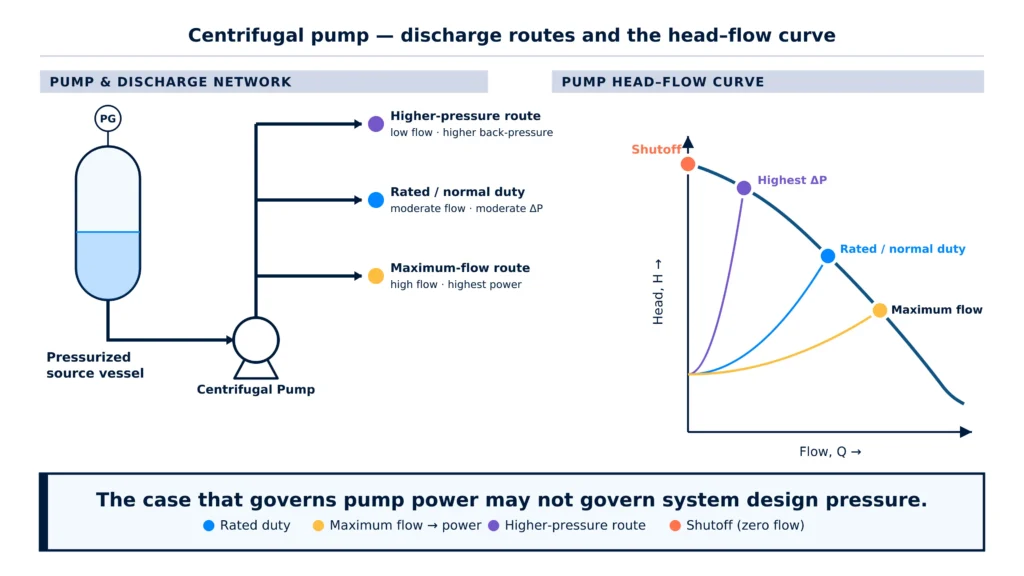
Treating one normal duty point as the answer to all three questions can understate the containment basis or oversize the driver. Each decision needs its own governing case.
Use pump sizing to establish the duty cases
With the pump in automatic sizing mode, Size for Flow lets the engineer specify the required flow while FluidFlow calculates the pressure rise required by the network. Run a separate case for every credible destination, lineup, tank level, equipment condition, and operating mode that can change resistance or boundary pressure.
Compare at least the resulting flow, duty pressure rise, suction pressure, discharge pressure, and hydraulic or shaft-power basis available from the model. The case requiring the greatest power may govern pump and driver sizing. The case producing the highest differential pressure may be more important to the pressure design review.
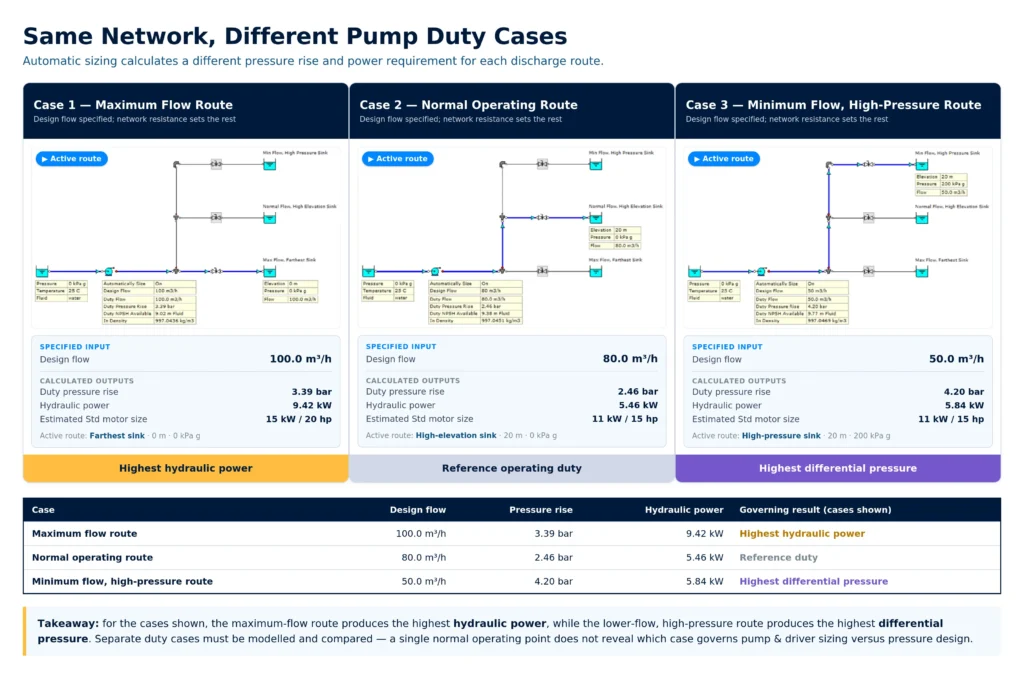
FluidFlow supports this comparison, using the Engineer’s understanding of the system’s different operating configuration and analyze each relevant condition to identify the governing case correctly. An omitted destination, an understated downstream pressure, or an unrealistically low suction pressure can change which case governs.
Run every duty case in one model
Use Size for Flow to compare flow, pressure rise, suction pressure and discharge pressure across each credible lineup, then see which case governs.
Role of Pump Duty on Design Pressure
For a system involving a pump, the design pressure is based on the governing calculated duty pressure rise. This pressure rise is multiplied by an approved internal or industry-standard factor representing the acceptable increase in pump head when the discharge is blocked. The maximum suction pressure is then added to establish the system design pressure.
The system design pressure is calculated using the relationship:

where is the maximum credible pump suction pressure, is the calculated duty differential pressure, and is the project-defined allowable rise to shutoff, expressed as a percentage rise to shutoff, expressed as a percentage.
Maximum Suction Pressure Contribution
Maximum suction pressure is the highest pressure the pump suction can experience under a credible condition. It is generally calculated as the sum of the highest pressure exerted at the liquid level surface at the liquid source and the coincidental pressure exerted by the liquid at the pump suction nozzle:

In the given expression, is the maximum credible pressure acting on the liquid surface, and the static head contribution is based on the fluid density (ρ), the gravity constant (), and , the vertical distance from the highest credible liquid level to the pump suction nozzle centerline.
For system design-pressure calculations, flow-dependent pressure drops are excluded because the governing shutoff case assumes zero flow. Under this condition, the pump develops its shutoff differential pressure.
For a vessel-fed pump, establish the suction-pressure basis from two independent choices:
| Source-vessel pressure basis | Liquid-level basis |
|---|---|
| Normal operating pressure | Normal maximum operating level |
| Relief-valve set pressure or other approved maximum pressure | Design maximum liquid level |
These choices create four possible combinations. The most conservative combination is not automatically the approved one. The engineer must determine whether the selected vessel pressure and liquid level can realistically occur at the same time and whether that coincidence is recognized by the approved calculation practice.
System Design Pressure Calculation Workflow
- List every credible operating lineup. Include normal, alternate destination, maximum flow, minimum flow, startup or filling where relevant, clean/fouled resistance, and tank-level extremes.
- Calculate the required duty for each case. Record flow, pump pressure rise, suction pressure, and discharge pressure.
- Identify the highest differential-pressure case. This represents the most severe differential-pressure operating condition for your system, and it may differ from the differential pressure in the pump-sizing (controlling) case. A lower-flow route can require higher destination pressure, elevation, or total friction loss due to a longer flow path.
- Establish maximum suction pressure. Determine the maximum suction pressure for the credible event that produces the highest suction pressure, in accordance with approved calculation practices.
- Calculate the resulting maximum discharge pressure. Applying the equation above.
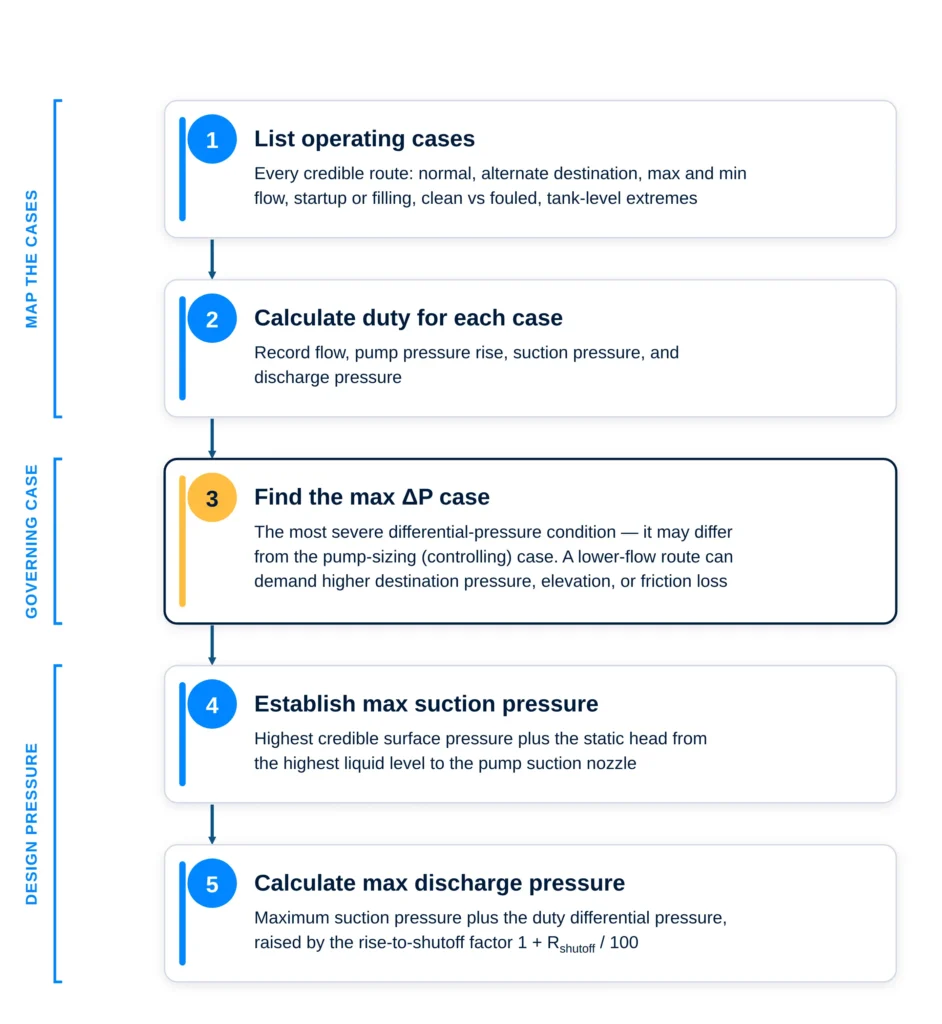
This sequence keeps pump selection, containment, and protection traceable without asking one duty point to answer three different questions.
What the model does not settle
FluidFlow reports the pressure profile, required duty, and selected pump performance for the cases supplied. It does not define what credible conditions exist to achieve the maximum suction pressure or what is the acceptable % head rise to shutoff for system.
FAQ
Does the highest pump duty set the design pressure?
Not necessarily. The pump-sizing case may require the greatest power, while another case may produce the highest differential pressure. The shutoff case may be higher still. Compare all credible cases and include the approved maximum-suction-pressure basis before assigning the discharge system design pressure.
Is duty pressure rise the same as shutoff head?
No. Duty pressure rise occurs at the operating flow. Shutoff head is the centrifugal pump’s differential head at zero flow. A selected manufacturer curve must be checked because its shutoff head may differ from the head rise assumed during initial sizing.
Can FluidFlow determine maximum suction pressure?
FluidFlow calculates suction pressure from the boundary conditions, liquid level, elevation, fluid properties, and suction losses defined in the model. The engineer must decide which vessel pressure and liquid-level combination is credible for the design-pressure case.
What if the selected pump exceeds the pressure basis at shutoff?
Calculate the actual shutoff discharge pressure and compare it with every exposed item’s design pressure. Then route the disposition—reselection, rating change, or protection measure—to the responsible engineering and safety review. The hydraulic result alone does not approve the solution.
Keep pressure cases separate from normal duty
A reliable design pressure basis starts with a complete operating case matrix, not a single rated point. Use pump sizing to establish the duties, use the manufacturer’s curve to establish the actual shutoff head, and combine it with the approved maximum-suction-pressure basis. The calculation identifies the pressure; the project’s design rules determine the rating and protection response.
FLUIDFLOW Free Trial
Build your case matrix in FluidFlow
FluidFlow calculates the pressure profile, required duty and selected pump performance for every case you define. You decide which conditions are credible, and your project’s design rules set the rating.