Dredging Profit: Blockage & Cavitation Analysis
Every minute your cutter suction dredge (CSD) is down, you’re not just losing time; you’re losing serious money. And often, the culprits aren’t obvious mechanical failures, but invisible, preventable issues lurking within your slurry transport systems.
The Hidden Costs of Slurry Pipe Blockage
Dredging operations face unique challenges that can devastate project profitability. As your dredge’s suction pipe adjusts its angle to tackle different depths, you’re unwittingly inviting two major operational headaches:
1. Increased Deposition Limit Velocity
When pipes change inclination, slurry particles want to settle more easily. The result? Blocked suction pipes that bring your entire dredging operation to a grinding halt. This isn’t just an inconvenience—it’s a direct hit to your bottom line.
2. Higher Pipe Friction Loss Leading to Pump Cavitation
More friction means your dredging pump works harder, reducing its Net Positive Suction Head Available (NPSHA). This directly leads to pump cavitation, a destructive phenomenon where vapor bubbles form and collapse, literally eating away at your pump components.
Both scenarios create the same painful outcomes: unnecessary downtime, crippling project delays, and a cascade of costs from emergency maintenance to missed contract deadlines.
Common Causes of Dredge Downtime
Understanding the root causes of dredge downtime is crucial for effective prevention. When operators rely on oversimplified analysis methods, they often make operational decisions that directly lead to costly failures:
Inadequate Flow Velocity Analysis
Standard analytical models lack the sophistication to account for the complex liquid-solid-pipe wall interaction inherent in dredging operations.
Selecting an inappropriate method for evaluating solids deposition velocity result in recommending mismatched operational settings.
Changing pipe orientations during normal dredging operations significantly affect settling solid behavior, but this impact is often underestimated.
Insufficient Pump Performance Prediction
Simplified NPSHA calculations create dangerous blind spots in predicting potential cavitation conditions.
Basic friction loss estimates fail to account for the complex behavior of slurries, leading to unexpected pump failures.
The absence of integrated system analysis prevents operators from seeing how individual components interact under changing conditions.
The inevitable result? Your operation becomes trapped in a costly reactive cycle — addressing emergencies rather than preventing them. You’re essentially battling invisible forces with unreliable data, making strategic planning nearly impossible and eroding profit margins with each unexpected shutdown.
The Problem with Traditional Slurry Analysis Methods
It’s not uncommon for dredging operations to rely on methods that make broad assumptions about slurry behavior in transport systems. These “best guesses” often oversimplify the complex dynamics of dredging operation.
Why Conventional Tools Fall Short:
- Outdated correlations that don’t reflect modern understanding of slurry flow
- Simplified assumptions that ignore critical factors like particle size distribution
- Poor integration Manual selection of deposition velocity correlations
The consequence? Calculations that falsely predict pump performance or blockage risk. Imagine halting operations for a pump inspection, only to find nothing wrong. Or making costly modifications to your dredge based on flawed analysis.
These aren’t just inconveniences; they’re direct hits to your profit margins, born from a lack of precise understanding of slurry transport systems.
FluidFlow V3.54: Advanced Slurry Pipe Blockage Prevention
What if you could accurately predict and prevent these costly issues before they even start?
FluidFlow’s V3.54 changes how dredging operations can be effectively analyzed. We’ve introduced cutting-edge methods that eliminate guesswork, giving you unparalleled insight and control over your slurry transport systems.
While preventing blockages is critical, the real game-changer is designing efficient slurry systems from the start. Most engineers spend 40-80% more time than necessary on slurry calculations using spreadsheets and basic tools. Learn how FluidFlow cuts slurry design time in half →
Deposition Velocity Analysis
Enhanced Deposition Velocity Calculations
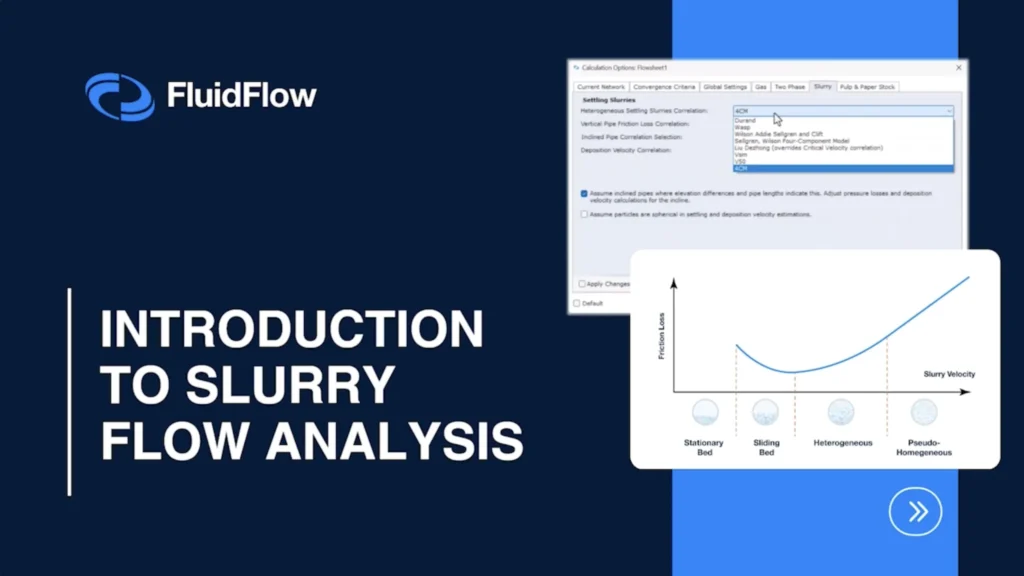
Forget manual selection of deposition velocity correlations. The new VSCALC method automatically and systematically selects the optimal correlation for calculating maximum deposition limit velocity from these sophisticated methods:
- Wilson – GIW
- Thomas 1979
- Wilson 1992
- Thomas 2015
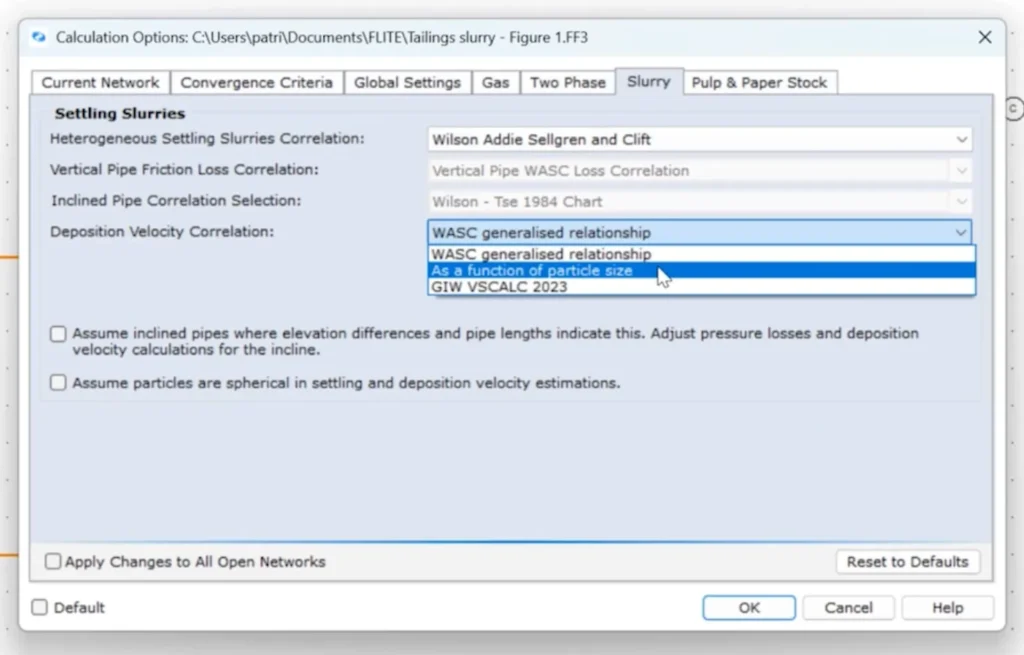
The result is far more accurate prediction of when your slurry is at risk of settling, allowing you to optimize flow rates and prevent costly pipe blockages in your dredging operations.
FluidFlow v3.54’s enhanced VSCALC deposition velocity calculations are part of comprehensive slurry systems modeling improvements that transform how engineers approach complex slurry applications.
Advanced Pipe Inclination Correction Methods
Improved Correction for Dredging Pipe Geometries
Previously, deposition velocity adjustment methods only relied on pipe slope in calculations. However, recent studies such as by Matousek et. al in 2019 observed that particle-to-pipe diameter ratio (d/D) is also critical for accurate deposition velocity analysis in slurry transport systems.
In FluidFlow V3.54, users have the option to adjust deposition velocity against pipe inclination using any of these methods:
- Wilson – Tse 1984
- Extended Wilson – Tse (New)
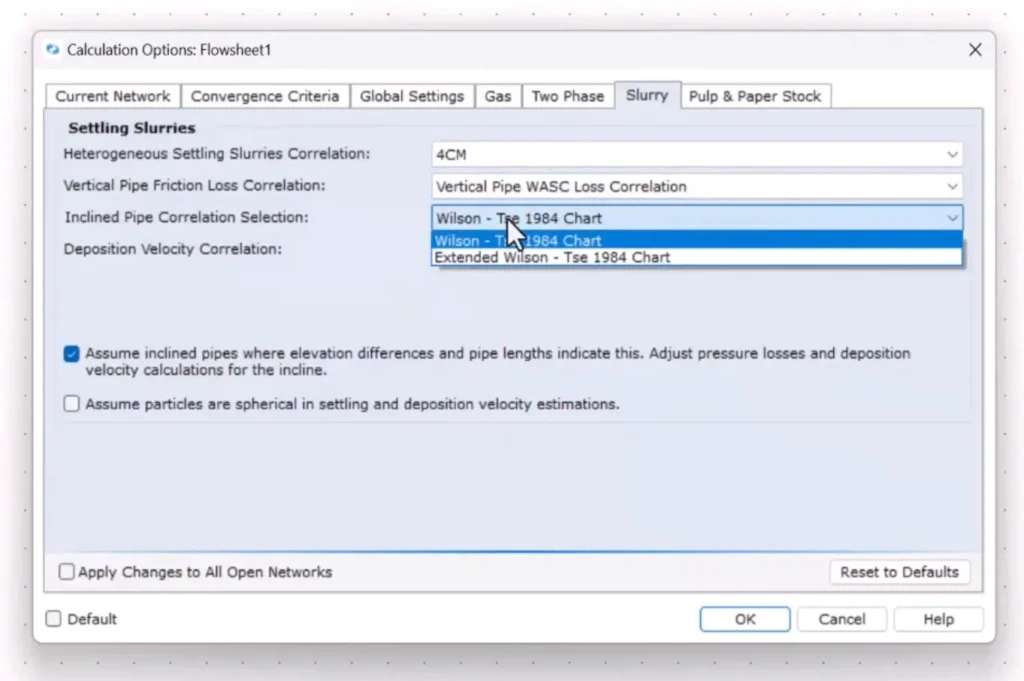
This gives dredging engineers a more accurate picture of slurry behavior across varying pipe orientations, dramatically reducing the risk of unexpected blockages.
Precision Pump Cavitation Prevention
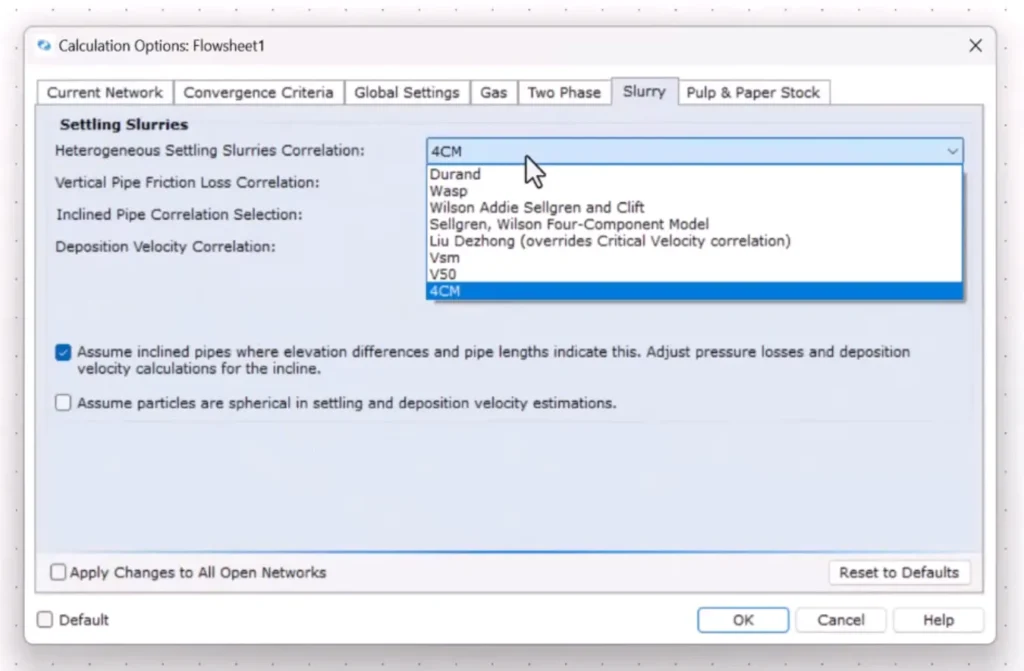
Updated Four-Component Model (4CM) for Friction Loss
FluidFlow V3.54 incorporates an updated Four-Component Model (4CM), offering the most accurate approach to solving slurry system friction losses in dredging applications.
By accounting for individual contributions of:
- Homogeneous components
- Pseudo-homogeneous components
- Heterogeneous components
- Stratified components
The 4CM provides a precise view of pressure losses, enabling better understanding of pump NPSHA and reducing pump cavitation risk to absolute minimum.
With FluidFlow V3.54, you’re not just getting the software; you’re gaining a strategic advantage for your dredging operations. Make data-driven decisions that prevent blockages, protect your pumps, and ensure your projects stay on schedule and on budget.
Frequently Asked Questions
Q: What causes slurry pipe blockage in dredging operations?
A: Blockages typically occur when flow velocity drops below the deposition velocity, allowing particles to settle. This is especially common when pipe inclinations change during dredging operations.
Q: How do you prevent pump cavitation in slurry systems?
A: Friction loss calculations using methods like the 4CM model help estimate NPSHA more accurately, allowing proper pump selection and system design to prevent cavitation.
Q: Why are traditional deposition velocity calculations inadequate for dredging?
A: Traditional methods often ignore critical factors like particle-to-pipe diameter ratios and use simplified assumptions that don’t account for the complex geometries common in dredging operations.
Q: Can FluidFlow model changing pipe inclinations during dredging?
A: Yes, FluidFlow V3.54’s advanced inclination correction methods account for varying pipe orientations and their effects on deposition velocity and friction losses.
Prevent Slurry Pipe Blockage Before It Happens
Don’t let preventable blockages and pump failures destroy your dredging project profitability. FluidFlow V3.54’s advanced analysis capabilities give you the precision needed to:
Eliminate unexpected downtime from pipe blockages
Prevent costly pump cavitation damage
Optimize flow rates for maximum efficiency
Reduce maintenance costs through better design
Model Smarter. Prevent Downtime.
Put FluidFlow V3.54 to work on your slurry transport systems and see the difference in accuracy and efficiency.
Master Slurry System Design Fundamentals
Want to see how FluidFlow simplifies complex slurry analysis beyond just dredging applications?
Gain practical insights into settling vs. non-settling flow, non-Newtonian behavior, and key slurry transport principles in just 30 minutes.