
Joule-Thomson Effect in Gas Calculations
To obtain maximum accuracy in gas calculations, particularly in systems where large pressure losses occur, the Joule-Thomson effect needs to be included in the solution. The J-T effect describes the increase or decrease in temperature of a real gas (as opposed to an ideal gas) or liquid as it flows from an area of high pressure to an area of low pressure without heat transfer to or from the fluid and no external mechanical work extracted from the fluid. An example of such a scenario would be a gas flowing through a perfectly thermally insulated throttling device such as a valve, nozzle or orifice plate.
Model J-T cooling across your gas network — real gas, real pressures. Free 14-day trial.
Joule-Thomson Effect — Definition & Key Facts
The Joule-Thomson effect is the temperature change that occurs when a real gas undergoes a throttling (constant-enthalpy) pressure drop through a valve, restriction, or control element with no external heat transfer.
The effect is quantified by the Joule-Thomson coefficient: μ_JT = (∂T/∂P)_H
Sign convention: If μ_JT > 0, temperature decreases as pressure drops (cooling on pressure reduction). If μ_JT < 0, temperature increases as pressure drops (warming on pressure reduction).
Why it matters in gas systems: Joule-Thomson cooling/heating can affect temperature limits, condensation risk, and hydrate risk during pressure reduction.
FluidFlow context: FluidFlow accounts for Joule-Thomson effects in steady-state real-gas network calculations as part of its compressible-flow framework. During pipe design, FluidFlow’s compressible gas flow workflow can model temperature change in a gas network arising from this effect.
Equations of state (general case): Peng-Robinson, Lee-Kesler, BWRHS. Hydrogen exception: FluidFlow applies a dedicated NIST Hydrogen method for hydrogen gas density; other hydrogen properties and Joule-Thomson behavior still follow the general real-gas framework.
The temperature change experienced during a Joule-Thomson expansion is quantified by the Joule-Thomson coefficient.
Joule-Thomson Coefficient
The temperature change arising from a reduction in pressure at constant enthalpy in the Joule-Thomson process can be expressed as:
μJT = (∂T/∂P)H
The value of μJT (oC/bar) depends on the gas type as well as its pressure and temperature before expansion. This coefficient may be either positive (cooling) or negative (heating). For all real gases, the value of μJT will equal zero at some point called the inversion point and the J-T inversion temperature is the temperature where the coefficient changes sign (where the coefficient equals zero).
The inversion temperature represents the temperature of a gas at which a reduction in pressure causes no temperature change. Above this temperature, the gas heats on expansion and below this temperature, the gas cools on expansion. When a real gas expands through a throttling device, the gas temperature may either increase or decrease depending on the initial gas pressure and temperature. Figure 1 provides an illustration of a typical temperature inversion curve.
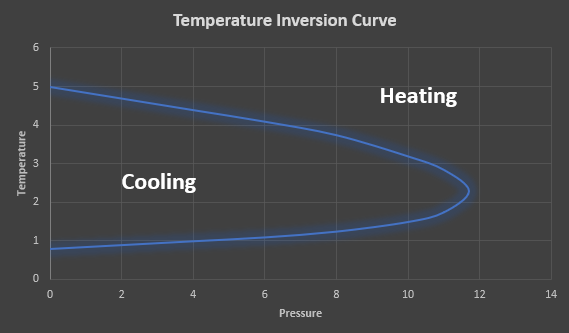
Figure 1: Temperature inversion Curve.
In gas expansion, the gas pressure reduces and thus the sign of ∂P is always negative. The following table explains when the Joule-Thomson effect heats or cools a real gas.
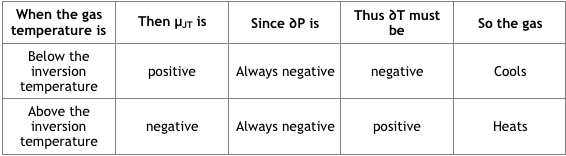
It is worth noting at this point that, there is no Joule-Thomson effect for an ideal gas. The value of μJT, therefore, equals zero, i.e., in theory, ideal gases neither heat or cool during expansion at constant enthalpy.
FluidFlow takes account of the Joule-Thomson coefficient when solving gas flow systems using real gas conditions. Figure 2 details the calculation of Joule-Thomson coefficient for a pressure control valve in a pipeline transporting a mixture of n-butane and n-pentane at a pressure of 11bar and temperature of 390K.
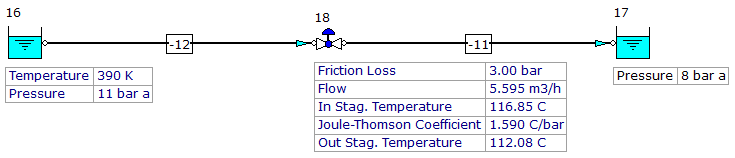
Figure 2: FluidFlow J-T Coefficient Calculation.
Model J-T cooling on your own Gas Network
Get up to speed and build your own model using our free training (with 14-day license)
knowledge base
Ready to apply this in FluidFlow?
Model Joule-Thomson cooling effects in your gas pipeline in FluidFlow — Gas Flow Webinar explains the correct use of FluidFlow’s gas modeling capabilities.
Model the Joule-Thomson effect across a full gas network. Start your free trial →