

Gas Pressure Drop Calculation: What Simplified Methods Miss
5 min read
You take inlet pressure, outlet pressure, one density, one velocity, and run Darcy-Weisbach on the whole gas line as if it were water. Then the plant delivers less flow than calculated, the farthest takeoff takes the most flow, or a branch does not meet the desired flow no matter how far you drop the downstream pressure.
That is the usual failure of a pipe pressure drop calculation that simplifies gas behavior. As pressure falls, gas density also drops, and mass conservation forces velocity to increase, which influences friction losses and introduces energy losses from gas expansion and acceleration.
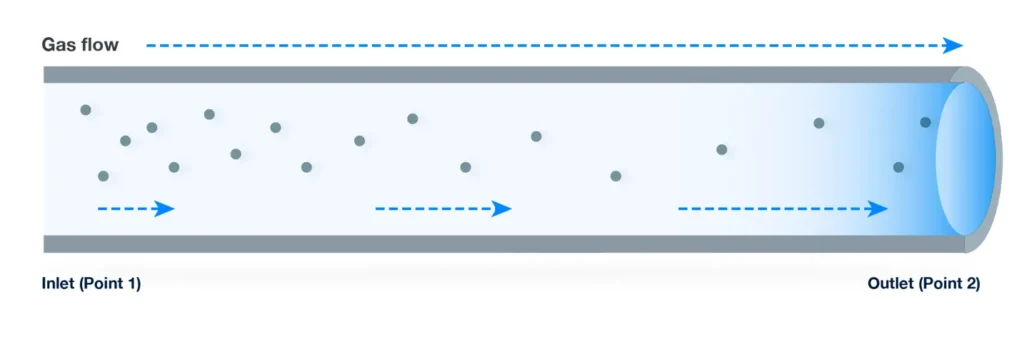
Why gas pipe pressure drop is a coupled property problem
In a liquid line, density is close enough to constant that volumetric flow at a junction, a single Reynolds number, and one friction factor. Gas does not give you that. Molecules are far apart. Raise pressure and density rises. Raise temperature and density falls. Drop pressure across a restriction and temperature can change even with no heat transfer to the wall because of the Joule-Thomson effect.
Mass continuity is unforgiving:

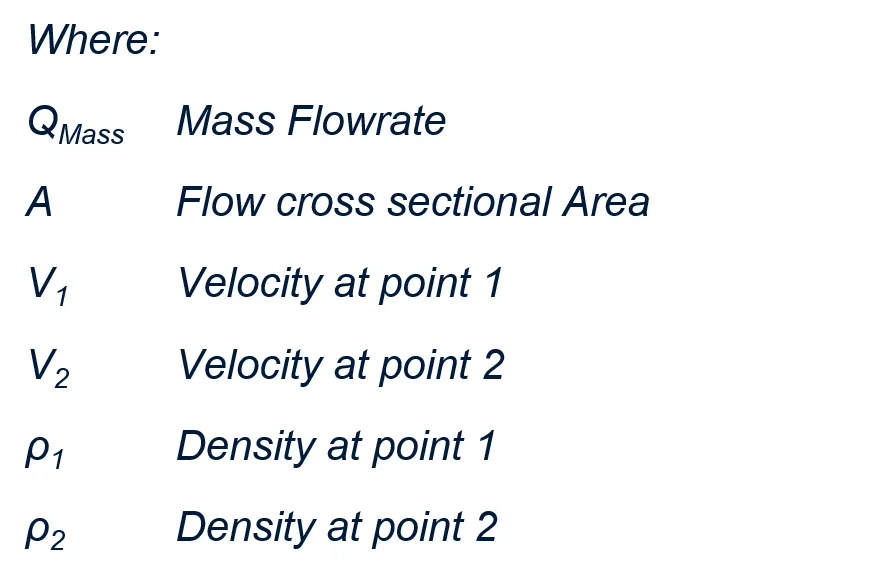
If density falls across a pipe diameter, velocity must increase. Actual volumetric flow therefore changes along the pipe to keep mass constant. Viscosity, Reynolds number, and friction factor can all shift with at local pressure and temperature. Specific heat feeds the energy balance; temperature then feeds back into density. Thermal conductivity does not set friction, but it does set heat transfer when the wall is in the model, and that heat transfer moves temperature, density, and ΔP again.
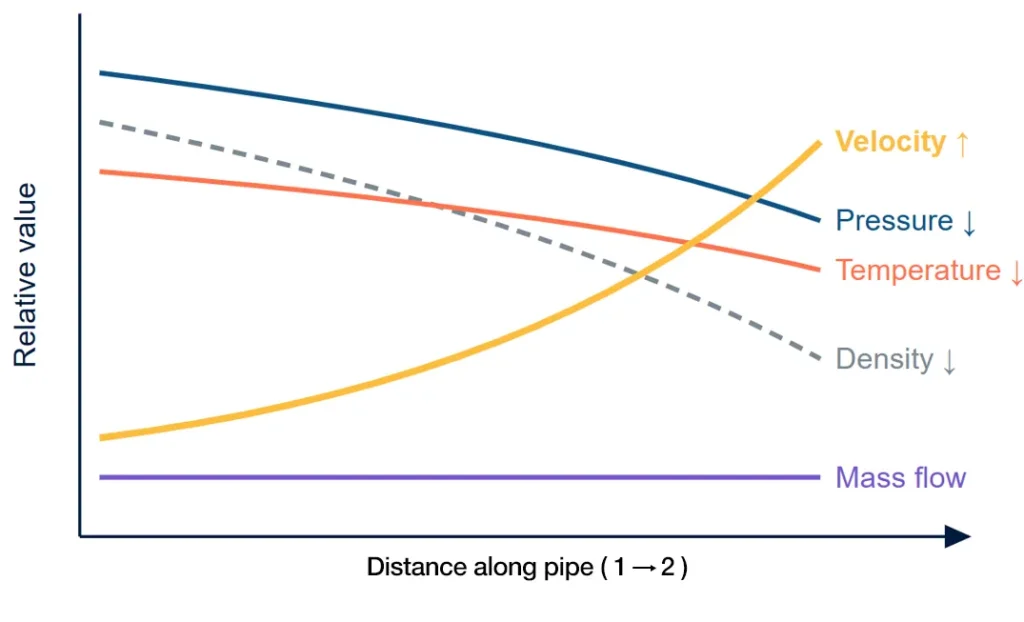
Why a single-property pipe pressure drop check fails on gas
Darcy-Weisbach remains a valid local friction relationship. The failure is applying it once, with one density, one velocity, and one f, to a fluid whose properties are highly dependent on temperature and pressure.
The usual hand method is the incompressible flow shortcut: assume that changes in density across a gas pipe are negligible so that the standard approach for liquids becomes valid. This approximation may be suitable when pressure and temperature changes are small enough that density variation is negligible. As the pressure drop increases, however, gas expansion raises the local velocity and introduces a momentum-flux contribution that the incompressible calculation does not capture. The approach can therefore understate the pressure difference required and overpredict the achievable mass flow in the system.
What makes compressible gas calculation accurate
An accurate calculation treats the gas as compressible behaving non-ideally, simultaneously solving mass, pressure, temperature, density, velocity, and viscosity together along the pipe.
- Recalculate properties at local pressure and temperature using an appropriate real-gas equation of state
- Incorporate energy losses from gas expansion and acceleration during pipe flow
- Include the momentum-flux contribution from gas expansion and acceleration.
- Accurately account for Joule – Thomson heating and cooling
- Recognize the limitation brought by sonic choking
FluidFlow’s gas module accounts for these effects using the Duxbury method, applying Darcy–Weisbach for wall friction while separately accounting for the momentum-flux effect of gas expansion and acceleration. It also incorporates real-gas property behavior to produce a coupled pressure-loss solution rather than a fixed-property approximation.
Run your gas network through FluidFlow’s Duxbury-method solver and check it against your design margin before you submit it.
FAQ
Can I use Darcy-Weisbach for gas pipe pressure drop?
Yes, locally. Not as one friction calculation on inlet density and inlet velocity for the whole pipe when pressure and temperature change significantly.
The outlet will not take the flow I specified. Is the model wrong?
Not if the Mach number at a restriction, expansion, or pipe exit is at or near 1.0. The line has reached sonic capacity. Lowering downstream pressure further will not increase mass flow through that plane. Change area or upstream conditions, or accept the choked rate. Do not keep a known-flow boundary on a system that cannot hold that flow.
Why does gas velocity increase as pressure falls?
As gas pressure falls, density generally decreases. For a fixed pipe area and conserved mass flow, velocity must increase as density decreases. This acceleration contributes to the required pressure difference and is one reason a constant-density calculation can overpredict achievable flow.
Why does the equation of state affect gas pressure-drop results?
The equation of state determines how gas density and other properties respond to local pressure and temperature. When real-gas behavior is significant, an unsuitable property method can distort the calculated density, velocity, and pressure profile. The selected method must suit the gas property and operating range.
What does the Duxbury method add to Darcy–Weisbach?
Darcy–Weisbach calculates wall-friction pressure drop. The Duxbury method applies that relationship while separately accounting for the momentum-flux effect caused by gas expansion and acceleration. This produces a coupled gas pressure-loss calculation rather than a single fixed-property estimate.
Why must a gas volumetric flow rate include a reference basis?
Actual gas volume changes with local pressure and temperature, so a value stated only in m³/h is ambiguous. Specify whether the flow is at actual conditions, STP, or NTP. Mass flow remains conserved, but actual volumetric flow can vary along the pipe.
Risks of Simplified Gas Calculations
Common gas pressure-loss shortcuts include treating density and velocity as constant, assuming ideal-gas behavior or a simple equation of state, and imposing a fixed thermal condition such as isothermal flow, where temperature is held constant, or adiabatic flow, where no heat transfer is assumed. These assumptions may be reasonable within a limited operating range, but they become unreliable when the actual pressure, temperature, and property changes depart from the assumed conditions.
Holding density constant ignores gas expansion and acceleration, which can understate the required pressure difference and overpredict achievable flow. A fixed thermal assumption may also miss heat-transfer or Joule–Thomson effects, while simplified property treatment can misrepresent real-gas behavior and the approach to sonic choking. Where these effects are significant, use a rigorous compressible-flow calculation that solves gas properties, wall friction, and momentum-flux effects together.
Stop estimating gas pressure drop.
Start solving it.
Model real-gas behavior, momentum-flux, and sonic choking together — not as a fixed-property guess.